Meet the Plants: Stinging Nettle
The Wild Green That Stings, Nourishes, & Asks Nothing of You But a Little Respect
Stinging nettle (Urtica dioica) has a reputation problem. Most unsuspecting people encounter it the wrong way, bare-legged and with immediate regret. But if you can get past the painful introduction, you'll see that behind the sting is one of the most nutritious, versatile, and genuinely interesting plants you're likely to meet.
It shows up at farmers markets, on farm-to-table menus, and in the foraging baskets of people who know better than to judge a plant by its defense mechanisms. Once you know nettle, you'll always find yourself scanning the edges of streams or shaded wood margins for its particular shade of green.
✿ ✿ ✿ ✿
How to Identify Stinging Nettle
Nettle is native to Europe, Asia, and North Africa, but has naturalized widely across North America. You'll find it most reliably in moist, shaded areas, along stream banks, at the edges of woodlands, in the rich soil of disturbed ground. It forms thick patches and spreads readily via underground rhizomes.
The most common species (Urtica dioica, also called Common or European Nettle) has several distinguishing features worth knowing.
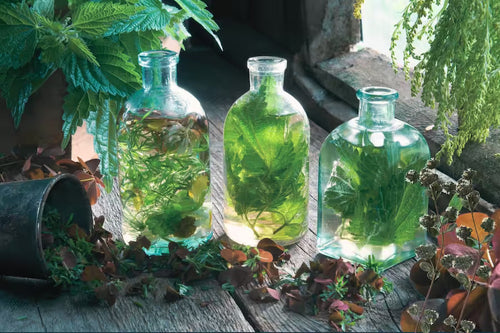
The leaves are opposite, triangular with deeply toothed edges, and have a slightly pillowy texture from their prominent veining. The stem is loosely square-shaped, with grooves running its length.
The hairs cover the entire plant, stem, leaves, and all, and are responsible for the characteristic sting. When they brush against skin, they break off and release a cocktail of irritating compounds including formic acid. The effect ranges from mildly annoying to quite uncomfortable depending on the person, and can last anywhere from a few hours to a day or two.
At the base of each leaf node, look for four small antenna-like appendages, a reliable identification detail. At maturity, nettle grows three to five feet tall, sometimes taller in ideal conditions.
The flowers are tiny and greenish, growing in dense clusters at the leaf nodes.
A note on the sting as an identifier: while it's a distinctive feature, other plants from different families can also sting. Always confirm identification using multiple characteristics, not just one.

Stinging Nettle as Food
Here's what makes nettle worth the effort: it's extraordinarily, wildly nutritious. Many herbalists and foragers consider it one of the most nutrient dense greens available in the wild.
Nettle is rich in vitamins A, C, and K, substantial amounts of iron, calcium, potassium, and manganese, and a whole range of antioxidant compounds.
It contains a meaningful amount of protein for a leafy green, often compared favorably to other native plants in this regards. It's earned the informal moniker of "Nature's multivitamin," and the nutrition data backs it up.
In flavor, it's often compared to spinach, earthy and green, but with a much more verdant depth. Cooked nettle loses its sting entirely and becomes tender and mild, making it surprisingly versatile.
How to harvest safely: Use gloves. Long ones. Harvest the young top leaves and shoot tips in the early spring, before the plant flowers, when the growth is most tender. Later in the season, the leaves become coarser and way less pleasant to eat.
How to prepare it: Blanch it briefly in boiling salted water for 30 seconds, immediately transfer to an ice bath to cool, then drain and use as you would any cooked green. The blanching water, rich in minerals, can be reserved and used as a simple nutritive tea or added to soup. (If you do plan on using the blanching water, it's always a good idea to give the greens a quick rinse beforehand.)
From there, nettle is welcome almost anywhere spinach would go: stirred into soups and stews, blended into vivid green pestos, folded into a frittata or quiche, pureed into a creamy spring soup.
It's also exceptional as a simple tea. Steep fresh or dried nettle in hot water and leave overnight before straining. The long infusion will result in a more mineral-rich and deeply nourishing infusion, particularly appreciated by those who feel depleted or run down.

A Few Notes on Medicinal Uses
Nettle has a long and well-documented history in herbal medicine, and modern research has begun to catch up with traditional use. It's most commonly used as a nutritive tonic, or simply put, a plant that builds and replenishes, as well as for its anti-inflammatory, diuretic, and antihistamine properties.
Of particular note: stinging nettle, prepared as an alcohol extract, has shown promise in studies looking at seasonal allergy support, where its natural compounds appear to interact with certain inflammatory pathways involved in the allergy response. Many herbalists use it preventatively in the weeks, and even months, leading up to allergy season.
It's also been studied in the context of joint inflammation and benign prostatic hyperplasia (BPH), with encouraging results in both areas.
A caution: Because nettle has a mild diuretic effect, it may be worth checking with a practitioner before using it medicinally if you take prescription diuretics, blood thinners, or blood pressure medication. As always, consult a licensed healthcare provider if you are pregnant, nursing, or managing any health conditions.
Other Uses Worth Knowing
Nettle has a history that goes well beyond the kitchen. Its fibers, strong, durable, and similar to hemp or linen, have been used in textiles for thousands of years, with evidence for nettle-fiber cloth dating back to the Bronze Age.
Some of that fabric, used in German military uniforms during both World Wars when cotton was unavailable, is reportedly still intact today. It's a remarkable plant in more ways than one.
✿ ✿ ✿ ✿
Enjoy Stinging Nettle in These Products
Wild & Weedy Finishing Salt

Nettle & Citrus Hydration Elixir

Into the Woods Herbal Tea

Disclaimer: These information provided in this article are for educational purposes only. Always positively identify any wild plant before consuming it. When in doubt, consult a local field guide or expert.