5 Edible Weeds Growing in Your Backyard Right Now
A Sweet & Simple Guide to Spring Foraging, From The Backyard to Your Kitchen Table
There's a particular kind of satisfaction in walking out your back door and coming back with dinner. Not in a survivalist way, just in the quiet, grounding way of knowing that the land outside your window has something to offer, and that you know how to receive it.
Spring foraging is like that. Before the farmers markets are fully stocked and the garden is popping out veggies, the edible wild plants come up first. Dandelion, chickweed, violet, and wood sorrel, tender, bright, and remarkably nutritious, arriving exactly when we need them the most.
This guide covers 5 of the most common edible weeds you're likely to find in a backyard, garden edge, or neighborhood green space. A few things first:
A note on foraging safety: Always make a confident identification before eating any wild plant. Use multiple field markers, not just one. The resources at the end of this post are a good place to start building that knowledge. When in doubt, leave it. And be mindful of where you forage, avoiding areas near roadside, treated lawns, or anywhere that may have been sprayed with pesticides or herbicides.
✿ ✿ ✿ ✿

1. Dandelion ✿ Taraxacum officinale
You probably already know this one. The deeply lobed, lance-shaped leaves forming low rosettes against the earth, the unmistakable sunshine-bright yellow flower, and the eventual ball of fluff that carries wishes out into the world. Dandelion grows in full to part sun, practically everywhere, and blooms from early spring through fall.
When broken, both the leaves and the stem will release a milky white latex, a reliable identification marker. Dandelion does have look-alikes, but none of them are toxic, making it one of the safer plants for foraging beginners.
One wildly good reason to eat it: Dandelion leaves are genuinely bitter, which makes them a natural digestive stimulant and tonic. The same bitter compounds that give them their characteristic bite are the ones that support liver function and digestion.
How to eat it: Young spring leaves are the most tender and least bitter. It's delicious raw in salads, wilted with olive oil and garlic, blended into pesto, or stirred into soups. The flowers are edible too, and are lovely scattered over a salad. Harvest in the morning when the flowers are fully open.
Toss wilted dandelion greens with a good olive oil, a splash of something acidic (we're partial to fire cider), and a pinch of finishing salt. It's a side dish totally worth making.

2. Chickweed ✿ Stellaria media
Chickweed is one of the sweetest signals that spring has actually arrived. It loves cool temperatures and nitrogen-rich soil. If you have a lush patch of it, your soil is in good shape. It will flower, go to seed, and disappear as soon as the heat comes, so catch it while you can.
To identify it, look for tiny star-shaped white flowers, a single line of fine hairs that run along one side of the stem (only one side, this is distinctive), and a fibrous cord running through the center of the stem that you'll feel when you gently pull the stem apart. Chickweed has no toxic look-alikes.
One wildly good reason to eat it: Chickweed is exceptionally mineral-rich, higher in calcium and iron per serving than spinach. It also contains plant compounds called saponins that help the body absorb those minerals more efficiently.
How to eat it: Its flavor is mild and slightly grassy, something like a more delicate pea shoot. Best eaten fresh, toss it into salads, layer it into sandwiches, or blend it into a bright spring pesto. It wilts quickly with heat, so if you're cooking it, add it at the very end.
Chickweed-infused vinegar, made with other mineral-rich herbs like dandelion and nettle, is a traditional preparation worth trying.

3. Purple Dead Nettle ✿ Lamium purpureum
Despite the name, purple dead nettle is completely unrelated to stinging nettle. It's actually in the mint family, and once you know what to look for, it's easy to spot: a square stem (a mint family hallmark), purple-tinged upper leaves, and a distinctive shape that's almost architectural.
It's best harvested in the spring and fall, when the stems are tender. Midsummer growth can be tougher and less pleasant to eat, especially since it's a little hairy.
One wildly good reason to eat it: Purple dead nettle is rich in antioxidant and anti-inflammatory flavonoids, vitamins A and C, and iron. It's also considered a mild antihistamine, a timely quality for a spring plant.
How to eat it: The whole aerial part of the plant is edible, stem, leaves, and flowers. It's covered in fine hairs, which some people find off-putting, but blending it into pesto or chopping it finely for a salad takes care of that entirely. It has an earthy, slightly umami flavor that pairs well with stronger herbs and good olive oil. And it can also be stirred into soups or cooked with other greens just as you would kale or chard.

4. Wood Sorrel ✿ Oxalis spp.
Wood sorrel is one of the most delightful finds in a spring yard. Heart-shaped leaves that look like a shamrock, tiny yellow flowers, and miniature seed pods that resemble the tiniest okra you've ever seen.
It grows nearly everywhere there's dirt and sunlight, and the leaves fold up each evening, reopening again each morning. Characteristics that are wildly charming, but also helpful identification details.
One wildly good reason to eat it: Wood sorrel gets its bright lemony flavor from oxalic acid, which also gives it a high vitamin C content. It's rich in anti-inflammatory antioxidants, including rutin, which supports cardiovascular health and collagen production.
A note: oxalic acid, in large amounts, can interfere with mineral absorption, so enjoy it as part of a varied diet rather than by the bowlful.
How to eat it: Its sour, citrusy flavor is what makes it special. A small handful scattered over a green salad adds brightness without any effort. It's wonderful blended into a vinaigrette or a garlicky herb sauce, or floated on top of a bowl of soup as a finishing touch. It doesn't keep well once picked, so enjoy it fresh.

5. Wild Violet ✿ Viola spp.
Wild violets are one of the most beautiful things about early spring. The heart-shaped leaves come first, low and deep green, followed by the small five-petaled purple flowers that are almost too pretty to eat. Almost.
With over 75 species of wild violet in North America, you're likely to find at least one in your yard.
One caution: lesser celandine (Ficaria verna) has similar heart-shaped leaves, but very different flowers (yellow with 8-12 petals versus violet's 5-petaled purple blooms). Harvest violet when the flowers are open and identifiable to be safe.
One wildly good reason to eat it: Both the leaves and the flowers are rich in vitamins A and C. The flowers are also high in rutin and other antioxidant flavonoids, and have a long history of use in herbal medicine as a gentle, cooling, moistening plant.
How to eat it: The flowers are mild and slightly sweet, lovely scattered over salads, frozen into ice cubes for summer drinks, or candied as a cake decoration. The leaves are best when young and tender, good in salads or wilted with other greens.
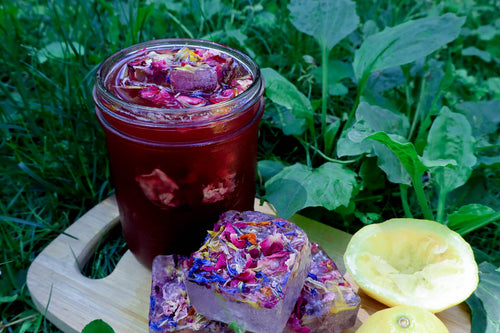
One of the loveliest things you can do with a good harvest of violet flowers: steep them, at room temperature, in white wine vinegar for a week or two. The vinegar turns the most extraordinary purple-pink color and carries a very subtle floral flavor that's beautiful in salad dressings, spritzers, or anywhere you'd use a flavored vinegar.
✿ ✿ ✿ ✿
A Few More Things Worth Knowing
These 5 plants are some of the most common and widely distributed edible weeds in North America, but they're just the beginning. Your yard or neighborhood may have others. And the more you learn to see them, the more the landscape shifts. What looks like weeds starts to look like a garden filled with tasty delights.
If you want to go deeper, these are some of the resources I return to most:
- Foraging & Feasting: A Field Guide and Wild Food Cookbook by Dina Falconi - thorough, beautifully illustrated, endlessly useful
- Backyard Guide to Edible Wild Plants by Mimi Prunella Hernandez and Heather Wood Buzzard
- Ugly Little Greens by Mia Wasilevich - great photography, solid recipes, and good information on ethical harvesting
- Botany in a Day by Thomas Elpel - for understanding plant families, which makes identification much more intuitive
- Chestnut School of Herbal Medicine - some of the best free herbal education available, with options for paid courses too
- Grow Forage Cook Ferment - practical, trustworthy, and genuinely inspiring
Happy foraging. Go slowly, pay attention, and eat something wildly good.
✿ ✿ ✿ ✿
Disclaimer: These information provided in this article are for educational purposes only. Always positively identify any wild plant before consuming it. When in doubt, consult a local field guide or expert.