Calm the Fluff Down: Herbal Teas for Anxiety, Stress, & Sleep
I never really noticed anxiety as part of my life until recent years. But when all is quiet at the end of the day, as soon as I lay my head down to sleep, something awful slips in.
Out of nowhere and for no good reason, I'm replaying every single thing I said and did that day or seven years ago, through a critical lens of self-doubt so unforgiving it keeps me up half the night, feeling small and stupid over things nobody else even remembers happening.
Can you relate?
Here you'll find:
- Why Anxious Minds Should Reach for Herbal Tea
- The 3 Ways Calming, Anti-Anxiety Herbs Work
- 10 of the Best Herbs for Stress & Anxiety
- Meet Our Herbal Teas for Stress & Anxiety
- Anti-Anxiety Tea FAQs
Why Anxious Minds Should Reach for Herbal Tea
If you're anything like me, there's comfort in the consistency of constant doing. Rarely a day goes by that I don't make a to-do list, either before bed or first thing in the morning. But crossing off to-do's, one after the other, no matter how good it feels in the moment, doesn't actually gets us anywhere on its own. If being excellent at staying busy were enough to fuel our soul's intent, none of us would know burnout this intimately.
You might handle instability or uncertainty differently. Maybe old habits or thought patterns resurface instead of to-do lists. We all have our own version of this story.
And fortunately, we have many wonderful plant allies for it.
The Simple Act of Sipping Tea
One of the easiest ways to bring herbs into your every day is through tea. It's about as low-effort as herbal medicine gets, just add water, and the right herbs can meet your nervous system exactly where it's at.
The trick is finding the quiet, and letting yourself actually sit in it. That's what gives your mind and heart time to catch up: to process what's happening, and figure out what role you're meant to play in it. These small pauses help you sleep more deeply, give shape to chaotic days, and build real resilience over time.
Preparing a cup of tea, then sitting down to drink it without rushing off to the next thing, is its own small act of self-care. Try a tea date with yourself daily, especially when things feel more turbulent than usual. Before bed is an easy place to start. Your moment of calm might last five minutes or fifty. Either way, it counts.
The earth provides so much for us. Food to sate our hunger, water to quench our thirst, beauty and mystery for our unending pursuit of the divine, and medicine for all our hurts.

✿✿✿
The 3 Ways Calming, Anti-Anxiety Herbs Work
Calming herbs are known for their effect on the nervous system. Classified as nervines, they tend to work in one of three ways:
-
Nerve tonics nourish and strengthen the tissues that make up your nervous system directly. Milky oats and tulsi are classic examples, helping to restore overall nervous system health in the face of chronic stress, exhaustion, and anxiety.
-
Nerve relaxants have a soothing, quieting effect, like a friendly hug for your nerves. Lavender is a good example here. It may help relieve stress headaches and support better sleep, though in high doses, relaxants can slip into sedating territory.
- Mild sedatives go a level deeper, suppressing central nervous system activity directly rather than just releasing tension, which is why this category is the one most linked to pain relief and inducing sleep. Poppy is a well-known example, helping to reduce pain and induce relaxation.
Most anti-anxiety herbal blends (including the ones below) can claim a combination of all three.
→ Learn more about herbal actions like nervines: A Plain English Guide to Understanding the Language of Plants
10 of the Best Herbs for Stress & Anxiety
Here's a closer look at some of the most reliable anti-anxiety herbs, and what they bring to the table beyond just "calming."
Lemon Balm
A lemon-scented member of the mint family, studied in several clinical trials for easing anxious mood without sedating. It appears to work partly through GABA support and a mild pull on the same brain receptors targeted by anti-anxiety medications, and it doubles as a gentle aid for restless sleep.
Oatstraw & Milky Oats
Harvested from the still-green stems of the oat plant, oatstraw is rich in magnesium and B vitamins, the raw materials a well-regulated nervous system runs on. It's often grouped alongside its more directly nervine sibling, milky oats, as one of the most nourishing herbs in the nervine family, working through steady, long-game mineral support rather than any quick calming effect.
Rose Hips
The fruit left behind after a rose blooms, rose hips are one of the most concentrated plant sources of vitamin C, an antioxidant your body burns through faster under chronic stress. Replenishing it helps support the adrenal glands that carry the load of ongoing anxiety.
Lavender
Best known for its scent, lavender also works internally as an antispasmodic and mild nervine, easing the tension anxiety tends to store in the body. Its most well-documented benefit is for sleep, where research consistently ties it to falling asleep faster and staying asleep longer.
Chamomile
Chamomile has a calming reputation that comes down to apigenin, a compound that binds to the same brain receptors as anti-anxiety medications, just far more gently. It's anti-inflammatory too, which matters given how much anxiety and inflammation feed each other in the body.
Skullcap
A North American nervine long used for anxious, overstimulated minds, skullcap suits the racing-thoughts, can't-sit-still version of anxiety especially well. Clinical research has found it improves mood in healthy adults without the grogginess of stronger sedatives.
Peppermint
Peppermint is classified as a nervine stimulant, gently perking up the nervous system rather than calming it, so its place on this list works differently than the others. The case for it comes down to the gut: anxiety and digestion are closely linked, and peppermint's best-documented action, a smooth-muscle antispasmodic effect well studied for conditions like IBS, eases the physical digestive tension anxiety often produces. Its reputation for calming the mind itself comes mostly from aromatherapy research (inhaling peppermint has been linked to lower cortisol and reduced anxiety), though the evidence is still considered preliminary.
Passionflower
Passionflower has been studied for anxiety head-to-head against pharmaceutical anti-anxiety medications, with some trials showing comparable results and fewer next-day effects. It's thought to raise GABA levels in the brain, the same calming neurotransmitter several of these herbs influence in their own way.
Tulsi
An adaptogen rooted in Ayurvedic medicine, tulsi helps regulate cortisol, the stress hormone that stays elevated far longer than it should once anxiety turns chronic. Multiple human trials link it to lower perceived stress and better sleep, making it more of a long-game herb than a same-day fix.
Ashwagandha
Another Ayurvedic adaptogen and one of the most clinically studied herbs on this list, ashwagandha has repeated, placebo-controlled trial support for lowering cortisol and easing anxiety, with several studies using the same Hamilton Anxiety Rating Scale doctors use to assess anxiety disorders. Like tulsi, it works best as a steady daily habit rather than an in-the-moment fix, which is why you'll find it in a few of our herbal honeys meant to be used in your every day.

✿✿✿
Meet Our Herbal Teas for Stress & Anxiety
Dream Weaver Herbal Tea leans on chamomile and skullcap for steady, trustworthy calm, with peppermint, blue cornflower, and anise hyssop adding a bright, aromatic lift. Steep it when your thoughts won't quit after dark, it's built to ease tension and carry you into deeper, more restorative sleep. It's the one I reach for to release the day.
Support Group Herbal Tea takes a different route into the same family, hawthorn, oat tops, rosemary, rosehips, rose petals, and skullcap, built specifically for a heavy heart. Reach for it when anxiety sits more in your chest than your head, hawthorn supports the physical heart while rose and skullcap ease the emotional weight riding along with it. This is the cup for the days when it's less about winding down and more about steadying yourself back up.
Extra Nervous System Support:
Tea + Herbal Honey Pairings for Stress & Anxiety
If you want another layer of support beyond the cup itself, a few of our herbal honeys are built around the same calming, nervous-system-focused herbs, just delivered through a spoon instead of hot water. Stir into your tea and let both work at once.
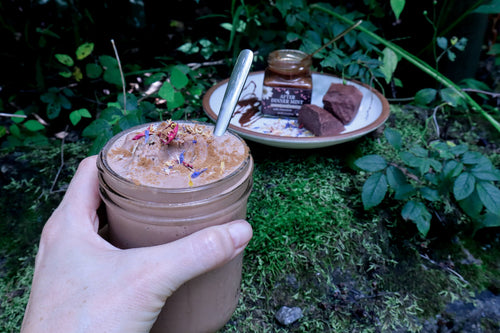
Chamomile & Calm Herbal Honey carries chamomile, skullcap, and anise hyssop, the same trio behind Dream Weaver, plus ashwagandha for extra resilience against ongoing stress and a touch of ginger to round it out.
→ Try this: Pair Chamomile & Calm Herbal Honey with Dream Weaver Herbal Tea for a doubled down version of the same calm.
Charmed & Delighted Herbal Honey carries hawthorn, rose petal and rosehip, the heart-focused herbs at the center of Support Group, plus warming ginger.
→ Try this: Stir a spoonful of Charmed & Delighted Herbal Honey into Support Group when you want the emotional-support side of that blend reinforced.

→ Try this: Our Evening Routine Trio for Deep Rest, everything you need to wind down, bundled. A full evening set: Dream Weaver Herbal Tea after dinner, Chill Pill Herbal Honey stirred right in, and Moon Garden Herbal Sleep Elixir for the last 20 minutes before bed. Three ways to ease the nervous system into deep rest.
✿✿✿
Anti-Anxiety Tea FAQs
What's the best tea for anxiety?
Honestly, there's no single best answer. The best herbs are the ones that work for your body. Our herbal teas for stress and anxiety are both so different, and there's a long history of use behind each of the herbs above for easing stress and supporting deeper sleep.
How much tea should I drink for anxiety?
There's no fixed number here either, and the herbs are only part of the picture. External stressors matter just as much. Give yourself five, ten, or twenty minutes to actually sit with your tea, whether that's in silence, with a book, or with a friend. Building that association, tea plus a stress-free moment, helps shift your body out of fight-or-flight and into a state where it can actually receive what the herbs offer.
✿✿✿
I wish I could tell you I've outrun the version of myself that replays every mistake before bed. I haven't. What's changed is smaller than that: some nights, a cup of tea is enough to give that noise somewhere to land instead of somewhere to grow. The herbs aren't meant to be an off-switch, just a friend to help lighten the load for a little while.
If you're in the thick of it tonight, I hope you find your own five minutes.
To living wildly well,

Founder, Botany Culture Co.
DISCLAIMER: The information given in this article is intended for educational purposes only.